
Frequently Asked Questions
 1.
What are plugs?
1.
What are plugs?
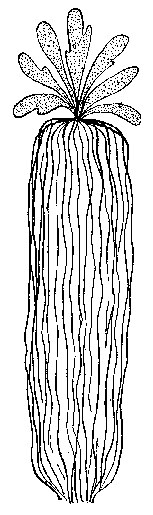
These are younger plants than those in the 4 ½” pots. They are well rooted seedlings approximately 1” in diameter and 4” deep. They are grown and sold in 5 packs or by the tray of 70 plugs. They come as 1 variety per 5 pack.
(see image on right)
2. How do I know how many plants I need?
As a general rule of thumb, a 1 foot spacing is recommended for planting. Therefore, if you have 100 square feet you would need about 100 plants which is 1.4 trays of plugs.
3. How much maintenance is required with native plants?
Much less maintenance is required than in traditional gardens. Once established, natives don’t require watering, fertilizing, deadheading, staking, regular mowing or winter covering. This eliminates a lot of garden chores. However, native plants do require some weeding. The amount of weeding depends on several factors: how well the site was prepared before planting, whether mulch was used and the style of planting. Mulch greatly reduces the amount of weeding required. Prairie style plantings generally take less weeding than Flower Bed style plantings because growth is denser. See the Planting & Seeding Guide for tips on preparing your site.
4. Why does your seed cost more than mixes sold in chain stores?
The mixes sold in chain stores contain a high percentage of annual flowers with a few perennials, none of them being native to the Canadian prairies. They may be wildflowers somewhere in the world but not here. They often look pretty and colourful the first summer but they decline rapidly after that. Prairie Originals mixes contain a variety of flowers and grasses that are native to the Canadian prairies. They are all perennial species that are more expensive to produce but they will provide a colourful, long lasting prairie. Our seed is all hand collected, ensuring that there are no weed seeds in the mix.
5. Do you sell Lady’s Slippers?
No. I am working on them but they are incredibly slow. These plants are very difficult to propagate from seed, which is like dust. Plants that have been grown from seed are very slow growing and take 8-10 years to bloom, so any plants you find for sale will be very expensive. We do not recommend that you dig them from the wild . Many plants die during this process and it depletes our dwindling wild plants.
Check with www.nativeorchid.org for possible sources of nursery-grown plants.
6. Will these plants go wild and crowd out other desireable plants in my existing garden?
Genarally, No. Most of our wildflowers and grasses are quite well behaved in the garden. Almost all the grasses are clump or bunch grasses and they do not spread by roots to take over. Many of them are also quite ornamental in a garden setting. There are a few spreaders you might wish to avoid if you are concerned about this. These include Canada Anemone, Wild Mint, Prairie Sage, Sweet Grass. These spreaders are better in a larger property where you want to cover a lot of ground.
7. What are the traditional uses of these plants?
Please download this Fact Sheet for the Traditional Uses of many Native Plants.
Some reference books on the topic are:
- Plants of the Western Boreal Forest and Aspen Parkland by Johnson/Kershaw/MacKinnon/Pojar
- Wild Seasons: Gathering and Cookiing Wild Plants of the Great Plains by Kay Young
- Edible Wild Plants of the Prairie – An Ethnobotanical Guide by K. Kindscher
- Medicinal Wild Plants of the Prairie – An Ethnobotanical Guide by k. Kindscher
- Edible Wild Fruits and Nuts of the Prairie by Turner & Szczawinski
- Native Medicine by Kahlee Keane
- Harvesting the Northern Wild by Marilyn Walker
- Edible & Medicinal Plants of Canada by MacKinnon, Kershaw, Arnason, Owen, Karst, Hammersley Chambers
DOWNLOAD
CATALOGUE
WILDFLOWERS
GRASSES
SHRUBS
VINES
GARDEN
COLLECTIONS
SEED MIXES
SEED by
SPECIES
OTHER
PRODUCTS
PLANTING &
SEEDING
GUIDE
PHOTO
GALLERY
RECOMMENDED
READING


Phone/Fax 204-785-9799 Toll Free 1-866-296-0928 Email